
Reciprocating Continuous Tri-Kneader™ Mixer
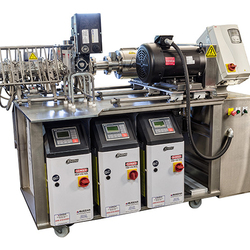
B&P Littleford's Tri-Kneader™ Compounder is the most advanced reciprocating kneader available for precision continuous compounding. As the original North American manufacturer of the Single-Stroke Co-Kneader, B&P Littleford brings over 80 years of hands-on experience to every machine we build — and the Tri-Kneader is the direct result of these eight decades of mastery in continuous kneader technology, improving on time-tested design to deliver greater process flexibility and performance for today's production demands. Built for compounders in the polymer, wire and cable, PVC, and specialty materials industries, the Tri-Kneader delivers ratings of Excellent across dispersive mixing, distributive mixing, devolatilization, melt temperature control, self-wiping, and output rate — outperforming both twin-screw extruders and traditional Co-Kneaders across every key metric.
Request a Quote
Tri-Kneader™ Compounder Features
B&P Littleford engineers designed the Tri-Kneader to surpass both twin-screw extruders and legacy co-kneaders across every key performance category. Its defining innovation — a unique triple-axial oscillation system that delivers three full strokes per 360° revolution — enables a compounding process unlike anything else on the market:
- 3× the mixing intensity of the traditional Co-Kneader, amplified through multiple interaction points
- Up to 144 interactions per rotation (vs. 6–8 for a standard Co-Kneader), with 12 barrel pins per row vs. only 3–4
- Reduced wear and controlled shear/heat — unlike the increased wear and increased shear/heat of the legacy Co-Kneader
- 100% self-wiping design that ensures rapid product changeovers and complete cleaning, eliminating material stagnation
- Customized shaft design — total freedom to configure the shaft for your specific material requirements
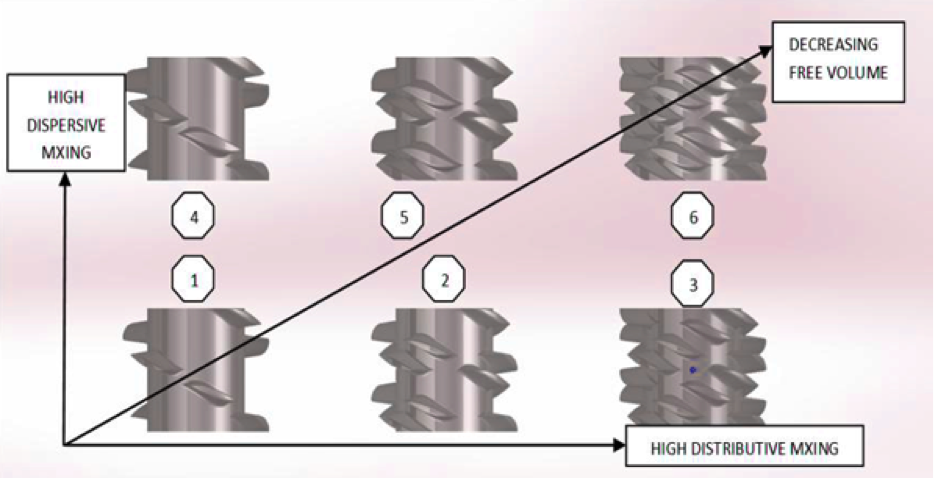
- Diverse element geometry — a wide variety of modular elements, including 8, 12, 16, and 24-flighted options
- Up to 60% reduction in Specific Mechanical Energy (SME) compared to benchmark, proven through testing
- Higher throughputs at a much lower RPM, with a slower circumferential screw tip speed that reduces machine wear without sacrificing throughput rate
The Compounding Solution You Need
The Tri-Kneader is engineered for compounders who require precision, versatility, and reliability at scale. It is ideal for operations that demand:
- Precise melt temperature control without sacrificing output rate
- Superior dispersive and distributive mixing in a single continuous pass
- High-performance devolatilization of sensitive or reactive formulations
- Exact temperature and shear control without sacrificing production rates or filler levels for demanding compounds including PVC and Wire & Cable
- Processing of formulations that cannot be compounded by conventional means
- Superior product homogenization in a shorter footprint, resulting in higher throughput, reduced energy consumption per kilogram, and drastically faster changeovers
- Longer operational life, higher availability, less downtime and fewer replacement parts — translating to lower operational expense per pound of material produced
How the Tri-Kneader Operating Principle Works
The B&P Littleford Tri-Kneader redefines compounding through a unique triple-axial oscillation system. While legacy Co-Kneaders — including those pioneered by B&P since the 1940s — rely on a single shaft stroke per rotation, the Tri-Kneader delivers three full strokes per 360° revolution.
By breaking free from the mechanical limitations of traditional single-stroke reciprocating kneaders, the Tri-Kneader utilizes a sophisticated slalom-pattern interaction between discontinuous element flights and stationary barrel pins — providing compounders with significantly greater flexibility in element selection and process tuning.
This triple-stroke action enables a high-frequency process cycle of Separation → Folding → Compression → Shear.
Prove Your Process: The B&P Littleford Technology Center
Choosing a new compounding technology is a critical decision. We invite you to eliminate the guesswork and prove your results before you invest.
Located in Saginaw, Michigan, our 16,000-square-foot facility is one of the most comprehensive process laboratories in the United States.
- Confidential Evaluations: Our staff of experienced engineers and technicians handle dozens of confidential product evaluations every year.
- Empirical Analysis: Conduct a "test spin" on the Tri-Kneader 30, 42, or 60 to calculate precise performance metrics for your specific materials.
- Scale-Up Confidence: The data operating parameters of your formulation are used to scale to the size needed for your production needs.
- Proof of Performance At Your Facility: Our TK-30 and TK-42 rental units are ready for deployment to your site, allowing you to validate your specific formulations and optimize process parameters in your own production environment.
- Optimization with "Dead Stop" Analysis: Our unique three-piece hinged barrel allows us to halt the process mid-stream and open the machine, enabling a direct, empirical evaluation of each unit operation for maximum optimization.
B&P Littleford offers the Tri-Kneader in six production sizes to match your output requirements, from lab-scale R&D to high-volume continuous production:
Tri-Kneader 30
Ideal for R&D, process development, and small-scale production validation. Available as a rental unit for on-site deployment. Output: 5–50 kg/hr (PVC) | 3–18 kg/hr (XLPE) | 5–26 kg/hr (HFFR)
Tri-Kneader 42
Mid-range pilot and production unit. Available as a rental unit for on-site deployment. Output: 70–250 kg/hr (PVC) | 15–100 kg/hr (XLPE) | 25–130 kg/hr (HFFR)
Tri-Kneader 60
Production-scale compounding for mid-to-high volume operations. Output: 200–600 kg/hr (PVC) | 80–240 kg/hr (XLPE) | 80–280 kg/hr (HFFR)
Tri-Kneader 85
High-capacity production for demanding compound programs. Output: 570–1,550 kg/hr (PVC) | 225–630 kg/hr (XLPE) | 225–770 kg/hr (HFFR)
Tri-Kneader 120
Industrial-scale continuous compounding. Output: 1,600–3,650 kg/hr (PVC) | 640–1,500 kg/hr (XLPE) | 640–1,800 kg/hr (HFFR)
Tri-Kneader 170
Maximum-throughput production for the most demanding output requirements. Output: 3,100–7,900 kg/hr (PVC) | 1,210–3,200 kg/hr (XLPE) | 1,200–3,800 kg/hr (HFFR)
Let's Connect!The Tri-Kneader earns an "Excellent" rating across every core performance metric, outperforming both twin-screw extruders and single-stroke kneaders:
|
Performance Metric |
Twin-Screw |
Single-Stroke Kneader |
Tri-Kneader |
|
Dispersive Mixing |
Excellent |
Fair |
Excellent |
|
Distributive Mixing |
Excellent |
Fair |
Excellent |
|
Devolatilization |
Good |
Poor |
Excellent |
|
Melt Temperature Control |
Fair |
Good |
Excellent |
|
Self-Wiping |
Excellent |
Good |
Excellent |
|
Output Rate |
Good |
Fair |
Excellent |
|
Free Volume |
Variable – Limited |
Variable – Limited |
Variable |
|
Machine |
PVC |
XLPE |
HFFR |
|
Tri-Kneader 30 |
5–50 |
3–18 |
5–26 |
|
Tri-Kneader 42 |
70–250 |
15–100 |
25–130 |
|
Tri-Kneader 60 |
200–600 |
80–240 |
80–280 |
|
Tri-Kneader 85 |
570–1,550 |
225–630 |
225–770 |
|
Tri-Kneader 120 |
1,600–3,650 |
640–1,500 |
640–1,800 |
|
Tri-Kneader 170 |
3,100–7,900 |
1,210–3,200 |
1,200–3,800 |
The B&P Littleford Tri-Kneader has crossover capability that is not available on competitive reciprocating kneaders. It offers a wide range of process capability in traditional thermoplastics and thermoset applications, but has also been tested in areas such as food, anode paste, bio-compounds, reactive, and other various processes.
The Tri-Kneader is a premium solution for compounders across a very broad spectrum of application areas — from a very aggressive, high-energy, high-shear dispersive nature to a rather finesse, low-shear, distributive nature.
|
Application Area |
Description |
|
PVC Compounding |
Rigid and flexible PVC, including high-filler formulations |
|
Wire & Cable |
XLPE insulation and HFFR jacket compounds |
|
Thermosets |
Reactive compounding and crosslinked polymer systems |
|
Bio-Compounds |
Renewable and biopolymer formulations |
|
Anode Paste |
High-density carbon electrode compounds |
|
Food Processing |
Selected food-grade compounding applications |
|
Specialty Polymers |
Advanced engineered thermoplastics and difficult-to-process materials |
A significant percentage of tests performed at B&P Littleford were on formulations that processors were not able to compound by conventional means.
Let's Connect!Commercializing a Revolutionary Technology for your Benefit
We are inviting plastics, rubber, chemical and food processors to bring some of the most challenging formulations to run on the Tri-Kneader and discover the process performance improvements offered by it. You will get an empirical analysis of the mixing benefits that are inherent to the Tri-Kneader Compounder.
At B&P Littleford, we’ve been extensively testing the Tri-Kneader side-by-side with our twin-screw extruders and Ko-kneaders and in every case, we’ve been able to establish the above advantages processing on the Tri-Kneader over and above the incumbent technologies.
B&P Littleford is prepared and equipped to help you with your compounding and mixing needs. Take advantage of our experience and technology by contacting us to see what running the Tri-Kneader Compounder can do for your process and bottom line.
Let's Connect!Frequently Asked Questions About the Tri-Kneader™ Compounder
What is a Tri-Kneader Compounder?
The Tri-Kneader is the most advanced reciprocating kneader on the market, using the "kneading" principle (rotating and oscillating), but differing significantly from legacy co-kneaders in mechanical frequency and target versatility. As the original North American manufacturer of the Single-Stroke Co-Kneader, B&P Littleford built the Tri-Kneader on over 80 years of continuous kneader expertise — improving on time-tested technology to deliver greater process flexibility and performance.
How does the Tri-Kneader differ from a traditional Co-Kneader?
While legacy Co-Kneaders rely on a single shaft stroke per rotation, the Tri-Kneader delivers three full strokes per 360° revolution. This results in up to 144 interactions per rotation and 12 pins per row — compared to just 6–8 interactions and 3–4 pins per row on the traditional Co-Kneader — delivering controlled shear/heat and reduced wear rather than the increased shear/heat and increased wear of legacy designs.
How does the Tri-Kneader compare to a twin-screw extruder?
The Tri-Kneader earns an "Excellent" rating across dispersive mixing, distributive mixing, devolatilization, melt temperature control, self-wiping, and output rate — outperforming twin-screw extruders particularly in devolatilization and melt temperature control, where twin-screw extruders rate only "Good" and "Fair," respectively.
What materials can the Tri-Kneader process?
The Tri-Kneader delivers exact temperature and shear control for demanding compounds including PVC, Wire and Cable (XLPE, HFFR), and other specialized materials. It also offers a wide range of process capability in traditional thermoplastics and thermoset applications and has been tested in areas such as food, anode paste, bio-compounds, reactive, and other various processes.
What sizes does the Tri-Kneader come in?
The Tri-Kneader is available in six production sizes — TK-30, TK-42, TK-60, TK-85, TK-120, and TK-170 — covering output rates from 3 kg/hr up to 7,900 kg/hr depending on material and formulation. TK-30 and TK-42 rental units are ready for deployment directly to your production site.
Can I test the Tri-Kneader before purchasing?
Yes. You can conduct a "test spin" on the Tri-Kneader 30, 42, or 60 at our Technology Center to calculate precise performance metrics for your specific materials. Our TK-30 and TK-42 rental units are also available for deployment to your facility, allowing you to validate your specific formulations and optimize process parameters in your own production environment.
How much energy does the Tri-Kneader save?
The B&P Littleford Tri-Kneader has been proven to reduce the specific mechanical energy required to achieve a high-quality compound. In some instances, testing showed a reduction in Specific Mechanical Energy (SME) by as much as 60% of the benchmark.