
Gas/Liquid-Solid Extraction Equipment
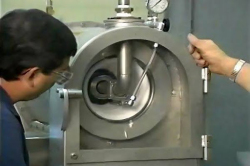
What is Gas/Liquid-Solid Extraction?
Gas/liquid-solid extraction is a three-phase separation process used when a feed stream contains entrained or evolved gas alongside a liquid carrier and suspended or crystalline solids. Rather than running material through a series of single-purpose machines, gas/liquid-solid extraction resolves all three phases in one sealed operation: solids are recovered as a dewatered cake, the liquid phase is decanted or extracted, and gas or vapor is vented or recovered through a controlled outlet.
This approach is critical when the process generates off-gas during dewatering, when the solvent is volatile, or when the solid product cannot be exposed to atmosphere without contamination or hazard.
Why Use Gas/Liquid-Solid Separation?
Process streams that off-gas during separation create real production headaches: vapor blow-back through the feed, fines carried out with the gas, solvent loss, and contamination risk if the gas reaches downstream equipment. Conventional open centrifuges and filters were not designed for these conditions. You may consider gas/liquid-solid separation when:
- The feed slurry contains dissolved or entrained gas that releases under reduced pressure or during dewatering
- The process solvent is volatile and must be recovered to control cost or meet emissions limits
- The solid product is air-sensitive, oxygen-sensitive, or pyrophoric and requires inert blanketing
- Distillation is impractical because of heat sensitivity, similar boiling points, or azeotropes
- Open processing introduces contamination risk to a sterile or food-grade product

How Does Gas/Liquid-Solid Extraction Work?
Gas/liquid-solid extraction equipment relies on the density differential between phases, accelerated by centrifugal force well beyond what gravity alone can achieve. Slurry is introduced through a sealed feed funnel that promotes even cake distribution and protects crystal integrity. Inside the rotating chamber, solids collect on a rugged single-stage screen and feed liquors drain through capillaries that form as the cake builds. While in rotation, liquids are driven through the cake under centrifugal force, and the cake is advanced down the dewatering screen by the pusher plate's reciprocating motion.
Where the application also involves a gas phase, the unit is enclosed for vapor-tight service. Off-gas is captured at a controlled vent, routed to a condenser or scrubber for solvent recovery, or replaced with an inert blanket when the product chemistry demands it. The same machine that performs the gas/liquid-solid separation can therefore also support solvent recovery, emissions control, and inert-atmosphere processing without adding a separate unit operation.
Benefits of B&P Littleford Gas/Liquid-Solid Separation Equipment
Consolidating three phases of work into a single sealed unit is the headline benefit, but the practical advantages run deeper:
- Vapor-tight enclosure protects the product from atmospheric contamination and contains volatile solvents
- Single-stage screen design produces a thicker, well-formed cake that improves wash efficiency and product quality
- Gentle feed handling preserves crystal structure, reducing fines and the gas-entrainment problems that fines create
- Inert-atmosphere capability supports air-sensitive and energetic materials
- Continuous operation suits high-throughput production rather than batch-and-clean cycles
- Smaller footprint than separate centrifuge, filter, and gas-handling skids
What Equipment Does B&P Littleford Use for Gas/Liquid-Solid Extraction?
B&P Littleford configures the Pusher Centrifuge for gas/liquid-solid service when the feed contains coarse, free-draining crystalline solids and a vapor phase that must be controlled. The Pusher's sealed housing, single-stage screen, and reciprocating pusher plate make it suited to continuous three-phase work where cake quality and gas containment both matter.
For applications where the gas phase originates from solvent volatility during liquid extraction rather than from the solid itself, the POD Centrifuge (Podbielniak Contactor) provides hermetic flooded operation that handles solvents and eliminates the need for nitrogen purging during separation. For three-phase processes that require an upstream mixing or reaction step under inert conditions, our vacuum mixer/dryer and reactor lines integrate directly with downstream separation.
Selection depends on the chemistry, particle size distribution, gas load, and production target. Our specialists can trial your separation process at the Tech Center in Saginaw, MI, or arrange a rental S-200 unit to run at your facility.
What Industries Use Gas/Liquid-Solid Separation?
This process applies across a number of industries, including:
- Food and Beverage: Recovering crystalline products from fermentation broths and dewatering precipitates where CO₂ or other gases evolve
- Textiles: Separating fibers, sizing agents, and dye solids from process liquors that release vapor during dewatering
- Pest Control: Handling active-ingredient slurries with volatile solvents under sealed conditions
- Paints: Recovering pigment solids from solvent-based dispersions while containing VOC emissions
- Mining: Dewatering mineral concentrates and tailings where gas evolves from leach chemistry or aeration
Real Test Capabilities Before You Commit
A gas/liquid-solid extraction process behaves differently on every feed. Particle size, solvent volatility, gas load, and cake permeability all interact in ways that benchtop calculations cannot fully predict. B&P Littleford runs trial separations on production-class equipment at our Saginaw Technology Center, or ships a rental unit to your facility through the rental program. Either path lets you validate cake quality, throughput, gas handling, and solvent recovery on your actual material before committing to a full system.
FAQs
What is the difference between gas/liquid-solid extraction and standard liquid-solid extraction?
Standard liquid-solid extraction handles two phases: a solid matrix and a solvent. Gas/liquid-solid extraction adds a third phase, vapor or entrained gas, that must be contained, vented, or recovered during the same operation. This requires sealed equipment, controlled vent paths, and often inert blanketing rather than the open-frame designs typical of two-phase work.
Can a single machine handle all three phases, or do I need separate equipment for each?
A properly configured pusher centrifuge with a vapor-tight enclosure and controlled vent can resolve all three phases in one sealed operation. This consolidates capital cost, reduces footprint, and eliminates the transfer steps where gas, fines, or solvent are most often lost between machines.
How is solvent recovery handled during gas/liquid-solid separation?
Off-gas from the centrifuge is routed through a vent line to a condenser or scrubber, where volatile solvent is condensed back to liquid for reuse. For high-value or hazardous solvents, a closed-loop recovery system pays back quickly through reduced raw material cost and emissions compliance.
Is gas/liquid-solid extraction equipment suitable for food-grade applications?
Yes. B&P Littleford builds pusher centrifuges in 316 stainless construction with surface finishes and seal designs that meet food and beverage industry standards. Sealed operation also protects the product from airborne contamination during dewatering.
What particle size and feed concentration does the process require?
The Pusher Centrifuge is best suited to coarse, free-draining crystalline slurries, typically 100 microns and larger, at feed solids concentrations from roughly 30 to 70 percent by weight. Outside that envelope, our specialists can recommend a different separation approach or a pretreatment step.
Can I trial my material before purchasing equipment?
Yes. B&P Littleford provides trial runs at our Saginaw, MI Technology Center and rental units that ship to your facility. Both options let you validate the process on your actual feed material before committing to a production system.
Ready to Discuss Your Gas/Liquid-Solid Separation Application?
B&P Littleford has been engineering centrifugal separation and extraction equipment for industrial processors for decades. Whether you are designing a new line or troubleshooting an existing three-phase process, our team can help you specify the right equipment and prove out the process on your material.
Request a Quote | Contact Us | Call 989.757.1300